
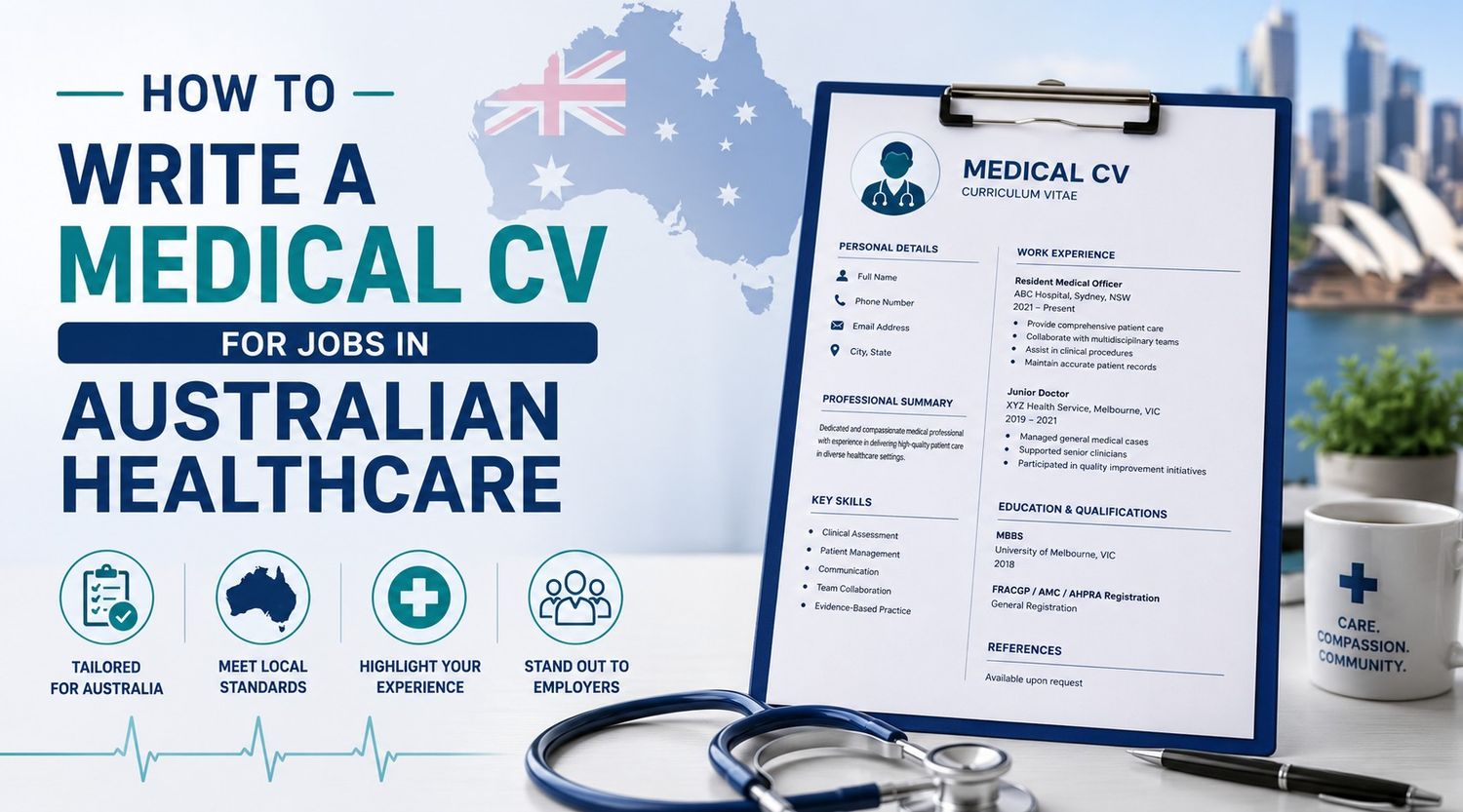
When you apply for healthcare roles in Australia, you need to do more than list your qualifications and work history. Whether you are a doctor, nurse, allied health professional, International Medical Graduate, resident medical officer, specialist or healthcare executive, your CV needs to clearly demonstrate your clinical skills, professional credibility, registration status, experience and suitability for the Australian healthcare system.
A well-structured medical cv Australia employers want to be clear, accurate, evidence-based and easy for recruiters, hospitals, clinics and healthcare organisations to assess. A medical CV is different from a generic CV in that it often has to include clinical placements, professional registrations, hospital experience, procedural skills, research, publications, audits, teaching, conferences and continuing professional development.
We know how competitive the Australian healthcare job market can be at DocTree. Your CV is the first impression you make before an interview, and it can directly affect whether your application moves forward or gets passed over. This guide will teach you how to write a professional medical CV for Australian healthcare jobs, and showcase your experience to improve readability, recruiter confidence and lead conversion.
Why an Australian Medical CV Is Important
Australian healthcare employers want to see candidates who can communicate their experience clearly and professionally. A good medical CV shows you understand local expectations, fulfil role requirements and can work safely and effectively in clinical settings.
The CV isn’t just a job application document for doctors and healthcare professionals. It is also a professional record of your clinical journey. Australian hospitals, private practices, locum agencies, recruitment teams and medical boards will use your CV to determine your suitability for a position, training pathway, fellowship, registration process or specialist role.
A solid medical cv Australia recruiters can quickly review must answer key questions fast:
Are you an Australian resident or eligible to vote?
What medical experience do you have?
Where have you worked? In what hospitals, departments, or speciality?
What systems, procedures and patient groups do you know?
Do you have experience in research, teaching, leadership or audit?
Are you right for the particular job they are advertising?
The clearer your CV answers these questions, the stronger your application is.
Begin With a Professional Header
Begin your CV with a clean and professional header that includes your full name, phone number, email address, location and professional title. Include your AHPRA registration status, specialist college membership or LinkedIn profile if applicable.
I’m not going to add any more words to what I’ve already said. Medical recruiters and healthcare employers want a professional, easy to scan format.
A potential header could be:
NAME
Title
Cell phone number
E-mail address
City and state
AHPRA registration number or status:
Linkedin profile professionally updated
For example, a junior doctor might write “Resident Medical Officer” or “General Registration Eligible Medical Practitioner” whereas a specialist might write “Consultant Anaesthetist” or “General Practitioner”.
Add a Powerful Professional Summary
One of the most important sections of your CV is the professional summary. It should provide a snapshot of who you are, your clinical background, your key strengths and the type of role you are looking for.
Keep this section short, sweet and sweet to the point. Skip vague words like “hard-working professional” or “team player” unless you can support the statement.
Some good professional summaries are:
Your present employment or job status
Years of clinical expertise
Speciality or area of health care
Status of Registration/Eligibility
Important clinical strengths
Objective of career for the position
Example:
“Dedicated medical professional with a varied background in Emergency Medicine, General Medicine, Surgical Rotations and Patient Centric Care in hospital settings. Proficient in clinical assessment, multi-disciplinary collaboration, procedural assistance and accurate documentation. “ Seeking a position as resident medical officer within an Australian hospital setting”.
This provides employers with a quick and practical summary of your value.
Add Registration and Eligibility Info
In Australia, registration status is critical for medical and healthcare positions. Please indicate clearly on your CV whether you are currently registered with the Australian Health Practitioner Regulation Agency (AHPRA) or are in the process of applying for registration.
Depending on your profession you may also have to declare your specialist college membership, fellowship status, limited registration, provisional registration, general registration or eligibility for a particular pathway.
This section is extremely important for International Medical Graduates. Your employer might need to know your AMC status, English test status, visa status and clinical assessment progress and if you are eligible to apply for Australian roles.
A clear registration section earns trust and helps recruiters to evaluate your profile faster.
Clearly Show Your Clinical Experience
The clinical experience section is the meat of your medical CV. Your work experience should be listed in reverse chronological order, starting with your most recent position.
The role should include:
Title:
Hospital, clinic or healthcare organisation
Address
Employment dates
Division or speciality
Main duties
Clinic accomplishments
When you talk about your experience, focus on practical responsibilities and measurable results. Don’t copy generic job descriptions. Instead, tell them what you did in the role.
For example, rather than writing:
“Worked emergency.
You can write
Assessment and management of acute presentations in a busy emergency department under supervision of a consultant including triage support, initial investigations, treatment planning and co-ordination with multi-disciplinary teams.
This sounds more professional and gives the employer a better perspective of your clinical ability.
Tailor your CV to the job
It is a common mistake for healthcare professionals to send out the same CV for every job they apply for. In Australia, employers respond best to a strong medical cv that is tailored to the specific role, speciality, level of seniority and healthcare setting.
If you are applying for an emergency medicine role, highlight acute care, triage, resuscitation support, procedural skills, emergency presentations and fast-paced clinical decision making.
When applying for a GP position, emphasise your background in continuity of care, chronic disease management, preventive care, communication, care planning, and community health.
When applying for a nursing position, emphasise patient care, medication administration, clinical documentation, infection control, wound care, care coordination and any relevant ward experience.
Your CV should never be tailored to your qualifications. This means putting the most relevant information first and making it easy for people to see why you’re right for the job.
Emphasises Critical Clinical Skills
A clinical skills section can be helpful for making your CV easier to read. This section will be of particular interest to doctors, nurses, allied health professionals and locum applicants.
Your role, skills may include:
Patient Evaluation
Keeping clinical records
Emergency Assistance
Medication management
Help with processes
Rounds of the ward
Planning for discharge
Chronic disease care
Surgical support
Telehealth appointments
“Interpretation of diagnosis”
Communication across disciplines
Patient education
Electronic health records
Match your skills to the job. Don’t list too many broad or unrelated skills. The aim is to demonstrate to the employer that you have the practical skills required for the position.
Add Education and Credentials
Your education section should include your medical degree or healthcare qualification, the name of the institution, country and year completed. Where appropriate, provide the official degree name and Australian assessment details if you completed your qualification overseas.
You can also add postgraduate qualifications, diplomas, fellowships, certifications and specialist training.
These are:
MBBS, MD, BMed, MBChB
Bachelor of Nursing
MPH (Master of Public Health)
College fellowship specialist
Advanced Life Support
Basic Life Support (BLS)
Advanced Paediatric Life Support
Training for mental health
Training in infection control
For Australian healthcare applications, having up-to-date and relevant mandatory training and certifications can be a valuable addition to your CV.
Add Research, Publications, Audits, & Presentations
Many medical employers are looking for people who are involved in research, quality improvement, audits, teaching and clinical governance. If you have experience in these areas, add a separate section.
You can specify:
Published studies
Poster presentations
Presentations at Conferences
Clinical Audit
Quality improvement project.
Teaching sessions
Participation in medical education
Development of guidelines
Case reports
Please leave this section organised and concise. Use a standard citation style where appropriate and include dates, titles and your role in the project:
This section can be particularly useful for specialist training applications, hospital jobs, academic positions and competitive registrar pathways.
Add Professional Development & Training
Continuing professional development demonstrates your commitment to learning and maintaining the safety of your clinical practice. CPD is highly regarded in Australia among health professionals.
Relevant Courses, Workshops, Certificates and Clinical Training: This may include life support courses, specialty-specific workshops, communication training, leadership programmes, cultural safety training or clinical systems training.
This may include Australian healthcare orientation, AMC preparation, or local clinical observerships for International Medical Graduates.
Use the Correct Format and Layout
Your medical CV should be clean, professional and easy to read. Recruiters are often reviewing many applications, so clarity is key.
Use: ”
Headings Clearly
Standard spacing
Professional font
reverse-chronological order
* Bullet points for ease of reading
Simple formatting
PDF format unless otherwise noted
Haven’t
Over-engineered templates
Large text blocks are
Email addresses that are unprofessional
Spelling & Grammar Errors
Dates do not match
Unexplained gaps in employment
Irrelevant personal info
Too much colour/graphics.
Most healthcare professionals can have a medical CV that is longer than a standard resume, but it still needs to be well organised. Junior doctors and early-career healthcare professionals might have a CV of two to four pages, while specialists and academics may need a longer document.
Tailor your CV for Recruiters and ATS
Applicant tracking systems or structured screening processes are used by many healthcare employers and recruiting agencies. So your CV should include keywords that are relevant to the job you are applying for.
For example, if the job ad uses the terms “emergency medicine”, “AHPRA registration”, “clinical documentation”, “multidisciplinary team” or “patient assessment”, your CV should naturally include these terms where appropriate.
However, don’t keyword stuff. Your CV must still sound like you, and still be professional. The goal is to make your experience easy for humans and screening systems to read.
Common Mistakes in a Medical CV
“Even seasoned healthcare professionals can miss out on opportunities due to simple errors on their CV. Common problems encountered include: unclear registration status; poor formatting; missing dates; generic summaries; too much personal information; and the CV not being tailored to the role.
Another common issue is listing responsibilities without demonstrating clinical relevance. Employers want to know how much care you provided, what type of environment you worked in, and what value you added to the team.
Your CV must be accurate, truthful and checkable. Do not overstate skills, roles or responsibilities. Credibility is an issue in healthcare.
Why Partner with Doctree?
Writing a professional medical CV can be tricky, especially when applying for competitive health care jobs or transitioning into the Australian medical system. DocTree’s experts understand what Australian healthcare employers are looking for and how to format your CV to make it clear, professional and impactful.
We help doctors, nurses and allied health professionals, International Medical Graduates, specialists and healthcare job seekers to present their experience in a way that supports their career goals.
DocTree can help you if you are preparing your first Australian healthcare CV, refreshing an existing CV, tailoring a profile for a specific role or simply enhancing your professional presentation.
A well-written medical cv Australia healthcare employers can trust can increase your chances of being shortlisted, make a stronger first impression and help you apply with more confidence.
Final Thoughts
Your medical CV is more than a piece of paper. This is a professional summary of your clinical experience, qualifications, achievements and your readiness for healthcare roles in Australia. A short, tailored and well-structured CV can allow recruiters to quickly see that you’re a good match and help employers to move your application forward.
Looking for healthcare jobs and want your CV to reflect your true value as a healthcare professional? DocTree is here to help.
Take the next step towards creating a stronger medical CV for positions in Australian healthcare by Booking Now with one of our experts for a Consultation.
Frequently Asked Questions (FAQs)
1. What does a medical CV in Australia contain?
Your medical CV in Australia should include contact information, personal statement, registration, clinical experience, education, qualifications, certifications, clinical skills, research, audits, publications, presentations, teaching experience, professional development and references upon request.
2. What is the length of a medical CV in Australia?
The ideal length will depend upon experience. Junior doctors and early career healthcare professionals may have a CV of 2-4 pages. Specialists, consultants, researchers and senior healthcare professionals may need longer CVs to show publications, audits, teaching and leadership experience.
3. How to write a medical CV for Australian jobs in healthcare?
Begin with a professional header, add a concise summary, include your registration status, list your clinical experience in reverse chronological order, highlight relevant skills, add your qualifications and certifications, and tailor the CV to the role you are applying for.
4. Do I need registration with AHPRA on my medical CV?
Yes, if you are AHPRA registered put it clearly on your CV. Quote your status correctly if you are still applying or eligible for registration. Your registration details are important for Australian healthcare employers reviewing your application.
5. What is the difference between a medical resume and a CV?
A resume is typically shorter and focuses on general work experience. A medical CV is more detailed and may include details of clinical training, hospital attachments, procedures, research, publications, audits, teaching, certifications and professional registration.
6. Can International Medical Graduates apply with a CV from overseas?
International Medical Graduates can seek employment in Australia but they are advised to adapt their CVs to the standards of the Australian healthcare system. Clear statement of Qualifications, clinical experience, AMC status, English test results (if applicable), Registration pathway, Visa status (if relevant), Australian healthcare exposure.
7. references in my medical CV?
The job advertisement may ask for references. If it does, include them. References available if required. For medical posts, referees are usually consultants, supervisors, clinical directors or senior healthcare professionals who can confirm your work.
8. How can DocTree improve my medical CV?
DocTree can help you prepare, update, structure and optimise your CV for Australian healthcare jobs. Our experts can help doctors, nurses, allied health professionals and International Medical Graduates develop a professional CV that is clear, relevant and employer ready.
9. What keywords do I put in a medical CV for Australia?
• Current AHPRA registration (or eligible to obtain) • Experience in clinical assessment and patient care in an acute setting • Experience in emergency medicine and/or general practice • Experience in a hospital setting • Experience working within a multidisciplinary team • Experience in clinical documentation • Experience in procedural skills • Experience in quality improvement activities • Speciality specific experience relevant to the job
10. I need help writing medical CV in Australia. Where can I get it?
DocTree is there to give you professional support. Book Now with one of our experts for Consultation to get guidance on how to craft a strong, job-ready medical CV for Australian healthcare roles.