
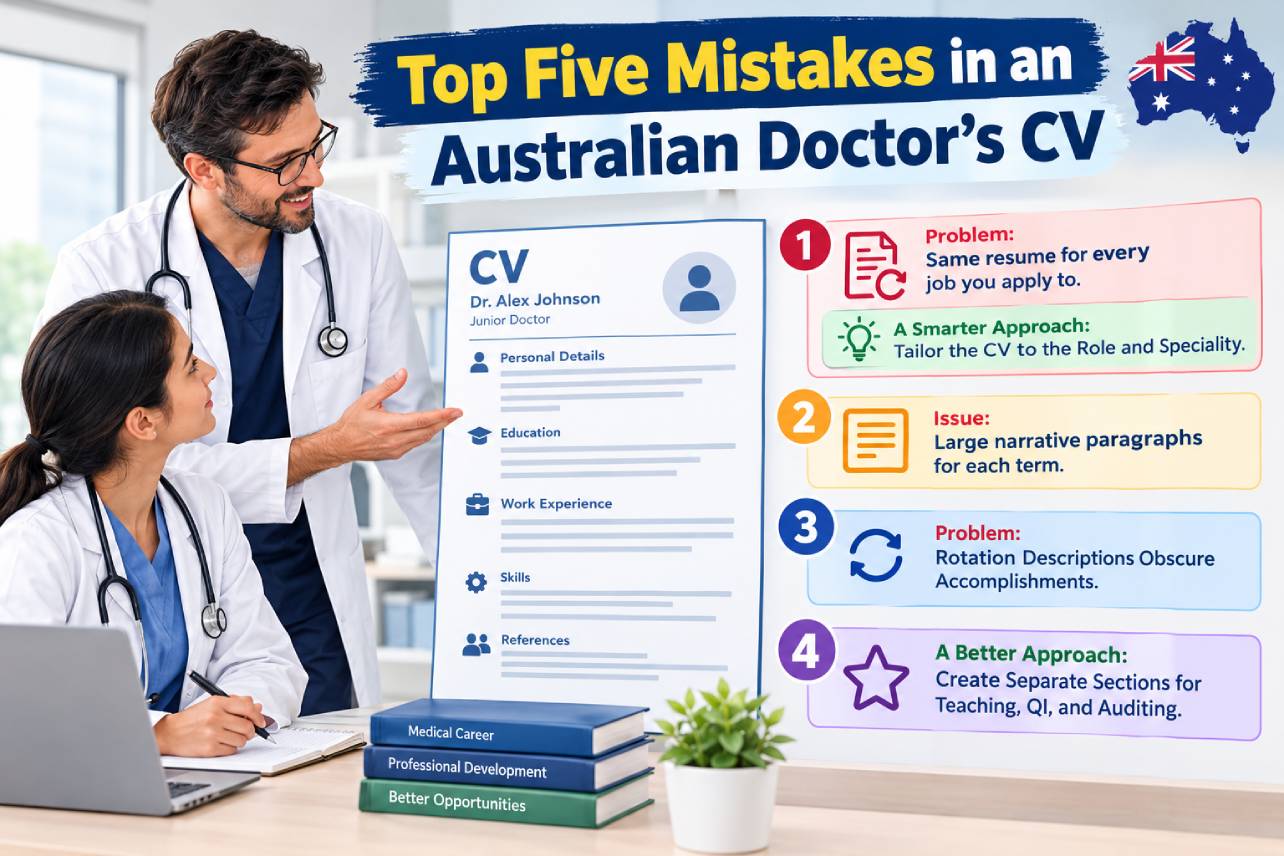
A good CV will help doctors clearly state their credentials, clinical experience, professional accomplishments and career advancement when applying for medical positions in Australia. However, many applicants tend to make common mistakes on their medical resumes, making it difficult for recruiters and employers to evaluate their applications.
A solid medical resume should be well-organized, easy to read, relevant to the position and customised to the candidate’s career objectives. Even experienced physicians can struggle when their achievements are unclear, their resume is too general, or they lack important information.
Candidates need to understand these common doctor’s cv mistakes to spot flaws and learn how to improve a doctor’s CV before submitting an application. Five common problems, their importance, and better ways to write a professional doctor’s resume are discussed below.
What if you send the same resume to every job you apply to?
Problem: Same resume for every job you apply to
One of the biggest mistakes doctors make is sending the same CV to every job they apply for. Medical roles can have different criteria based on speciality, hospital, level of training and responsibilities.
A generic resume might list all your experiences, but it may not make it clear why you’re a good fit for the role.
What Does Weak Speciality Alignment Mean?
Recruitment panels and employers want to know how your background fits the role. If your CV is not tailored it may be difficult to find relevant credentials, clinical expertise and achievements.
For instance, if a doctor is applying for a job in anaesthesia, their occupation development and relevant clinical experience should be clearly articulated.
A Smarter Approach: Tailor the CV to the Role and Speciality
Read the job description before submitting your resume. Revise professional profile, related experience, accomplishments and skills to show alignment with the position and speciality.
Tailoring doesn’t mean you rewrite your entire resume for each application you submit. “This is to highlight the information that is most relevant to the specific role.
Why do doctors make the mistake of writing long narrative paragraphs on their CVs?
Issue: Large narrative paragraphs for each term
Some doctors use long paragraphs to explain each clinical rotation. Long explanations can be informative, but lengthy blocks of text can make a CV difficult to scan.
It’s important that information is easy to find, as hiring panels and recruiters may have to look through a lot of applications.
Why It is Matters and How Difficult to Scan Quickly
Long paragraphs can hide important information about your duties & experience. A reviewer may not immediately see your clinical responsibilities, procedural skills, leadership activities, teaching experience, or other contributions.
Otherwise a good (Curriculum Vitae) CV can appear disorganised because of this.
A Better Approach and Use Short, Scannable Bullet Points.
Use bullet points to outline your main duties and any relevant experience. The most essential information should come first. Don’t include unnecessary details.
A clear format makes your (Curriculum Vitae) CV easier to read and helps the reviewer find your experience faster. Pinpoint on the responsibilities and achievements that are relevant to the job you are applying for.
What Happens When Rotation Descriptions Mask Accomplishments?
Problem: Rotation Descriptions Obscure Accomplishments
In long accounts of their rotations, doctors often highlight major accomplishments. Consequently, major contributions like audits, quality improvement projects, research, teaching or leadership experience were not properly recognised.
These achievements may be difficult to acknowledge when added to routine clinical responsibilities.
Why it Matters: Important Contributions Often Overlooked
Your resume should tell employers not only where you worked but also what you contributed. Rotation descriptions can hide important achievements that might be missed in the first assessment.
This is especially important for candidates who have been involved in audits, quality improvement projects, teaching, research, presentations or leadership.
A Better Approach: Create Separate Sections for Teaching, QI, and Auditing
Consider reserving specific areas for specific professional tasks such as:
- Quality assessment and quality improvement
- Teaching and Learning
- Research and publishing Conferences and presentations Leadership and management
You can add dedicated sections to make your contributions easy to recognise and show that they are above and beyond your normal clinical duties.
Why You Should Include AHPRA Registration Details on a Doctor’s Resume?
Problem: No AHPRA Registration Information
For doctors seeking suitable medical positions in Australia, registration information forms an important part of the application. Absence of or ambiguous registration details can result in unwarranted questioning at the initial review.
Some applicants bury this information lower down in their resumes where it may be less obvious.
Why Administrative Risk During Review Matters
When vetting an application, recruiters and employers may need to check the professional eligibility and registration status of a candidate.
If essential information is missing or difficult to find, the review process may be delayed. Clear presentations help to reduce unnecessary administrative problems.
A better approach would be to include registration details on page 1.
Make sure the relevant registration details are clearly visible on the first page of your resume. You should confirm the data is correct and up to date.
A well-structured beginning section will allow employers to better understand your professional experience, credentials and applicable registration information.
What do doctors need to check before submitting their resumes?
Before you send in your application, take a look at your resume and ask yourself:
- Is the CV tailored to the job and area of expertise?
- Can a recruiter easily identify my relevant experience?
- Have I used bullet points that are clear and concise?
- Are my major accomplishments easy to find?
- Have I included particular sections for teaching, auditing and quality improvement?
- Registration details; can I look them up easily?
- Do I have my spelling and formatting checked in Australian English?
- Does the CV show a clear logical career path?
Candidates can use these checks to spot common medical CV mistakes before submitting their applications.
How to improve my doctor resume for medical jobs in Australia?
Improving a doctor’s resume involves more than a simple correction of grammar or a change of layout. Autraliyan Candidates should be think about how effectively the document reflects their professional history and suitability for the position.
A good (Curriculum Vitae)CV should be:
- Relevant: Focused on the speciality and target job.
- Easy to understand
- Title should be make sense
- No need a additional story details.
- Achievement-oriented – Concentrating on major accomplishments at work.
- Accurate: Contains current and relevant professional information.
- Written in a experienced style, using Australian English, and consistent formatting.
By reading through these sections, doctors can create a CV that better represents their professional know-how and avoid many common mistakes.
Why use DocTree to Help with Doctor CV’s?
DocTree can assist doctors who wish to review and improve the format, content, and presentation of their resume. Getting a expert assessment can help candidate learn to good communicate their experience and identify areas that may need improvement.
Candidates of Australia can utilise DocTree to concentrate on those areas:
- Looking at the overall structure and layout of the (Curriculum Vitae) CV.
- Improvement of presentation and clarity of clinical experience.
- Noticing achievements you could miss.
- Improving the use of concise, professional language.
- Easier access to right expertise.
- Assisting those applicants who want to edit their resumes for some medical jobs.
- Comments on the presentation of professional material.
A well-designed CV can help doctors to better communicate their qualifications, achievements and experience.
In summation
A medical job application can make a doctor’s resume more clear and professional by avoiding common errors. Long narrative paragraphs, hiding key achievements, and not giving registration information properly can make a CV more difficult to assess, especially when the same resume is used for every job.
A better plan for doctors would be to customise their resume to the position and speciality, using concise bullet points, having a section on significant achievements, and featuring relevant registration details on the first page.
If you know these doctor resume mistakes and know how to rectify it, you can put together a CV for Australian medical jobs which is clearer, more structured and more professional.