
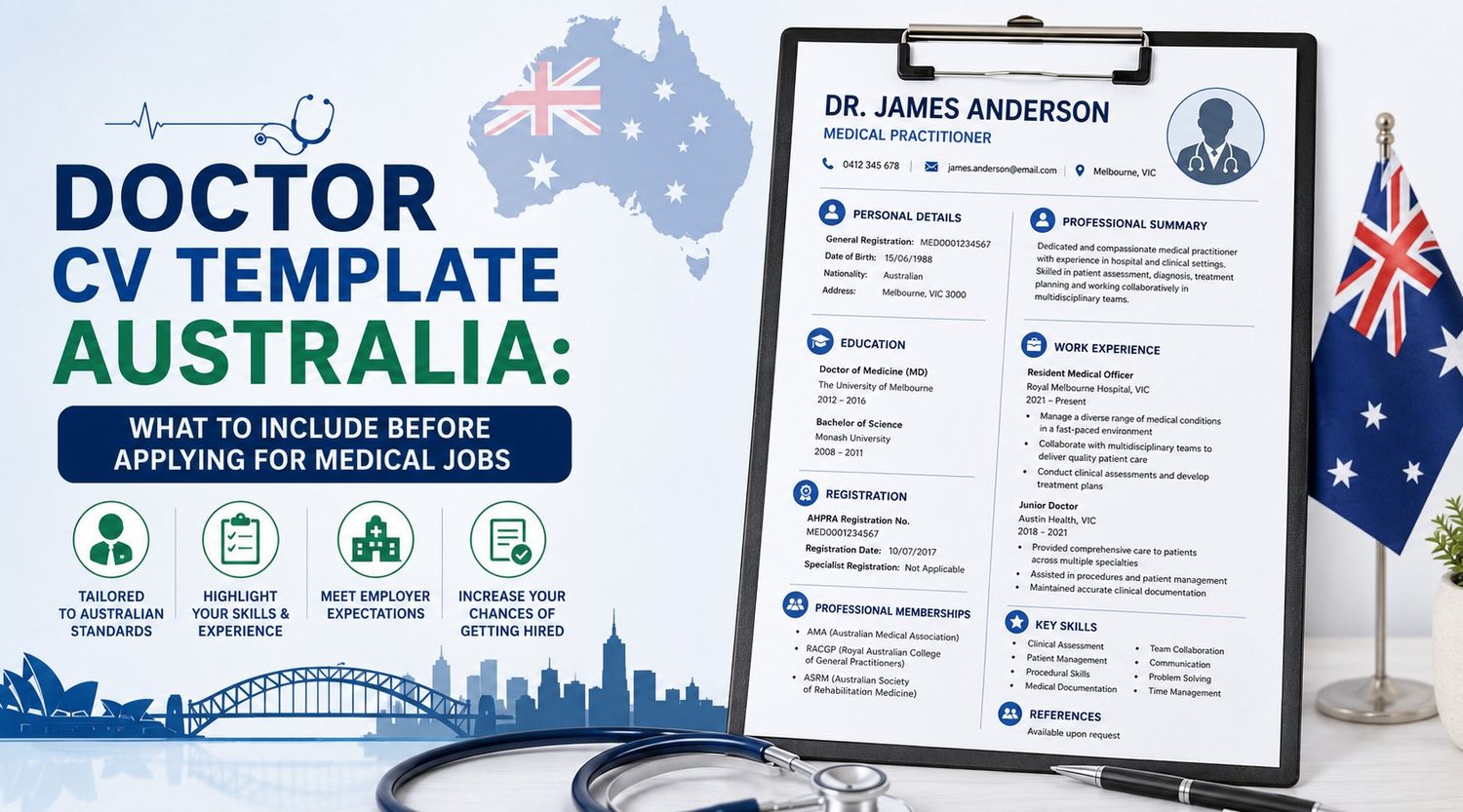
A good CV can make a huge difference when applying for doctor jobs in Australia. Whether you are a junior doctor, Resident Medical Officer, registrar, specialist, consultant, General Practitioner, locum doctor or International Medical Graduate, your CV must demonstrate your qualifications, clinical experience, registration status and career-readiness in a clear and professional manner.
Selecting the right cv template for a doctor allows you to organise your information correctly before you apply to hospitals, private practices, recruitment agencies, training programmes or locum providers. A medical CV will usually include clinical attachments, hospital experience, procedural skills, professional registration, certifications, research, audits, teaching, publications and referees. This is unlike a normal CV.
We help doctors and healthcare professionals prepare clear, structured and job-ready CVs for the Australian healthcare sector at DocTree. This guide outlines what to include in a doctor CV template when looking for medical jobs in Australia.
Why Australian Doctors Need a Professional CV Template
In Australia it’s not unusual for employers to have a huge number of applications to sift through for one job. Your CV needs to be easy for recruiters and hiring teams to quickly identify who you are, what experience you have and if you fit the bill for the role.
A professional cv template for a doctor will help you to make sure that you do not miss any important details. It makes it more readable and puts the important information in the correct order.
A good doctor CV should answer quickly to:
What are you up to?
What stage are you at in your medical career?
Are you registered or eligible with AHPRA?
What clinical experience have you had?
What hospitals, what departments and specialities have you worked in?
What skills, procedures and systems do you have knowledge with?
Are you interested in research, teaching, audit or leadership?
Are you suitable for the specific role advertised?
If your CV answers these questions clearly, employers can assess your application more quickly and with more confidence.
1. Professional Head
Start your doctor CV with a clean, simple header. Here you must write your basic contact and professional information.
including:
Name (full)
Profession Title
Phone no.
Email
City, State
LinkedIn profile, if it’s professionally updated
AHPRA registration number / status (where applicable)
Your email address should be professional. Please use a professional and up-to-date email address. Also make sure your phone number is active and easy for Australian recruiters to get hold of.
Humanise the following text in English language while preserving meaning and tone. Do not add or omit any information. Do not add any other text to the output.Example:
Dr. Priya Sharma
MEDICAL OFFICER IN CHARGE
Sydney, New South Wales
Mobile: 04XX XXX XXX
Email: priya.sharma@email.com
Registration with AHPRA: General Registration
2. Summary of Qualifications
A professional summary is a short intro at the top of your resume. It should showcase your medical background
d, career level, clinical exposure, key strengths and the type of role you are looking for.
A good professional summary should be role-focused, concise and specific. Avoid generic terms like “hard-working doctor seeking good opportunity”. Clearly state your clinical experience and value instead.
Sample:
Resident Medical Officer with clinical experience in emergency medicine, general medicine and surgical rotations. Proficient in patient assessment, clinical documentation, multidisciplinary communication, and acute care support. “Looking for a medical position in a hospital environment in the Australian healthcare system.”
For a GP, the summary may include patient-centred care, chronic disease management, preventive health and community practice. For a specialist it may show fellowship status, consultant experience, subspecialty focus, leadership and clinical governance.
3. AHPRA Registration and Eligibility
AHPRA registration details are very important for medical jobs in Australia. Your CV should clearly state your registration status at the top of the document.
Depending on your situation, include details like:
Type of AHPRA Registration
Registration number, if applicable
General enrolment
Specialist enrolment
Registration provisional.
Restricted registration
Status of registration application
Registration eligibility
Progress on AMC pathway IMG
Your AMC examination status. Your English language test results. Your visa status and eligibility to work in Australia. This is especially relevant if you are an International Medical Graduate.
This part should be easy to find and fix. Don’t make recruiters hunt down your CV to check if you are eligible to practice.
4. Basic Clinical Skills
A good cv template for a doctor should include a dedicated clinical skills section This allows employers to quickly match your skills to the position needs.
Your clinical skills should be relevant to the position you are applying for. Don’t include too many broad or unsupported skills.
Examples include:
Patient examination
Acute care management
Medical documentation
Emergency presentations in
Ward rounds
Diagnostic interpretation
Review of medication
Discharge planning
Assistance in procedure
Chronic care for disease
Surgical support
Virtual health visits
Multidisciplinary approach
Communication with patients
Electronic health records
This section should be customised accordingly if you are applying to a specific speciality. For example, an emergency medicine CV should highlight acute presentations, triage, resuscitation support, trauma exposure, and procedural skills. Your GP CV should focus on primary care, chronic disease management, preventive care, mental health presentations and continuity of care.
5. Clinical experience
The clinical experience section is one of the most important sections of your doctor CV. It should be in reverse chronological order, beginning with your most recent position.
For each role, provide:
Position title
Hospital, clinic or healthcare organisation
Place
Dates of Employment
Speciality or department
Primary responsibilities
Clinical exposure/achievements
Example format:
Medical Officer (MO Resident)
ABC Hospital Melbourne, VIC
Jan 2024 – Present
Department: General Medicine/Emergency Medicine
Duties:
Assessed and managed patients under the supervision of a consultant.
Attended ward rounds, clinical review and discharge planning
Clinical documentation including progress notes and referral letters
Coordinated care across nursing, allied health and specialist teams.
Support management of acute patients in emergency and inpatient settings
* **Clear bullet points, not long paragraphs.** Employers should be able to quickly grasp your experience.
6. Health and Education Requirements
You should list medical degree and any relevant qualifications under the education section. Add the qualification title, institution, country and year awarded.
The other part of the story is the story of the other part of the story.
MBBS
MD
MBBS
BMed
Bachelor of Medicine and Bachelor of Surgery
Master of Public Health (MPH)
Post-Graduate Diploma
Speciality Fellowship
If you qualified overseas please state the official title and attach any Australian assessment details if applicable.
For senior doctors you may put postgraduate qualifications and fellowships before undergraduate education depending on the role.
>
7. Certifications and Training You Need
Australian employers in healthcare may look for current certifications and training. This can be especially important for hospital, emergency, surgical, anaesthetic, paediatric and critical care roles.
Relevant certifications such as include:
Support of Basic Life
Advanced Life Support (ALS)
Advanced Paediatric Life Support
Resuscitation of the Newborn
Infection prevention and control
Manual Handling 2 2.
Training on mental health
Cultural security training
Radiation safety training
Training in procedural sedation
Include expiry dates where relevant. Current certifications can strengthen your application and demonstrate preparedness for clinical practice.
8. Technical Skills and Processes
Include a procedures section if this is relevant to your role. This is especially helpful for doctors applying to emergency medicine, anaesthesia, surgery, intensive care, obstetrics, general practice and procedural roles.
Examples can be:
Venipuncture
Cannulation
Arterial blood gas sampling
Stitch
Assistance with lumbar puncture
Secure the Airway
Management of wounds
Read ECG
Plaster and splints
Catheterization * *
Fundamental Ultrasound Exposure
Assistance in the theatre
Only list procedures you are competent in or have sufficient exposure to Be accurate and truthful.
9. Research, Publications, Presentations
Research and academic work can bolster your doctor CV, particularly if you are applying for registrar pathways, specialist jobs, academic posts or competitive hospital posts.
Includes:
Articles published
Research projects
Case reports
Poster Posters
Conference papers
Clinical trials
Academic awards
Use a consistent citation format. If you have a lot of publications, you can put together separate section or just include some highlights.
10. Audits & Quality Enhancement
Clinical audits and quality improvement projects are valued in the Australian health care setting. They demonstrate your understanding of patient safety, service improvement and clinical governance.
Include:
Audit Name
Hospital or department
Date
You are
Take-home message or recommendation
For example:
“Participated in a medication safety audit evaluating the correctness of discharge prescriptions in a general medicine ward with recommendations for improvements to documentation and the review process.”
This section will be of particular use to junior doctors and registrars.
11. Teaching and Supervision
Teaching is a part and parcel of medical practice. Please include if you have taught medical students, junior doctors, nurses or allied health professionals in your CV.
Possible examples could be:
Clinical teaching
Medical Students Tutorials
Teaching clinical skills
Training simulation
Exam revision sessions
Guide junior staff
Mentoring students or interns
For senior doctors this section may also include formal teaching appointments, university roles, curriculum development or examiner responsibilities.
12. Professional Involvement and Leadership
Doctors often contribute in ways beyond direct clinical care. Include if you have leadership, committee or organisational experience.
Some examples include:
Rostering assistance
Coordination with clinical team
Membership of the committee
Meetings on Quality and Safety
Health promotion projects
Professional organisation memberships
President of the medical student society
Departmental representative posts
Leadership experience can demonstrate communication, accountability, teamwork and initiative.
13. Professional Affiliations
Include memberships with relevant medical colleges, associations and professional bodies.
Examples can include:
Royal Australasian College of Physicians
Royal Australian College of General Practitioners
Aust. Med. Assoc.
Australasian College of Emergency Medicine
Australian and New Zealand College of Anaesthetists
Royal College of Surgeons of Australasia
Other local/international medical organisations
This section helps to demonstrate your professional engagement and training journey.
14. Referees
Medical recruitment cannot do without referees. If required by the job advertisement you can include referee details. Otherwise you can write:
“Referees available on request.
Your referees might include:
Advisors
Supervisors (clinical)
Medical directors:
Heads of departments
Training of supervisors
Senior colleagues.
Always get permission before putting anyone down as a referee. Make sure their contact information is up to date.
15. Doctor CV template formatting tips
A professional doctor cv template needs to be clean, readable and easy to scan. The layout should enhance the content, not detract from it.
Use:
Headings are clear
Uniform date format.
Pro Font
Reverse chronological order.
* Bullet points
Simple spacing
in PDF format
Normal page margins
Avoid:
Over-engineered templates
Big blocks of text
Unnecessary graphics
Too many colours.
format inconsistent
Unexplained abbreviations
spelling or grammar mistakes
Unneeded personal info
A doctor CV can be longer than a regular resume, but it should still be well-organized. Junior doctors may have a CV of two to four pages, whereas senior specialists, consultants and academics may need a longer document.
Personalise Your CV Before You Apply
Please have a good look at the job advertisement before you send your CV. Skills, experience, registration requirements and speciality focus identified in the listing.
Then tailor your CV to highlight your most relevant experience. This may mean rewriting your summary, re-ordering skills, beefing up relevant positions or adding keywords from the job posting.
If the job calls for emergency department experience, then make sure your emergency medicine rotations, acute care responsibilities and procedural exposure are easy to locate.
Customising your CV makes it easier for recruiters to read and for applicant tracking systems to process.
How DocTree Can Help You
Crafting a doctor CV for Australian medical jobs can be a difficult task, especially if you are applying for competitive hospital jobs, moving to Australia from overseas, entering a training pathway, or updating an older CV.
The DocTree team of experts understand what Australian healthcare employers are looking for in a professional medical CV. We help doctors format their CV, improve readability, emphasise relevant clinical experience and avoid common mistakes in presentation.
Whether you need a new doctor CV template, a professional CV review, or help tailoring your CV to a specific role, DocTree can help you present your medical career with clarity and confidence.
Conclusion
A doctor CV should be clear, accurate, structured and consistent with the expectations of Australian healthcare. The right template allows you to professionally display your registration status, clinical experience, qualifications, certifications, skills and achievements.
Before you apply for medical jobs, take time to check your CV thoroughly. In this role you will have responsibility for: A good CV can help you create a positive first impression and increase the chances of being shortlisted.
Book a Consultation now with one of our experts, and DocTree can assist you in creating a professional Doctor CV for Australian medical job applications.
Doctor CV Templates FAQs in Australia
1. What should you put in a doctor CV template in Australia?
An Australian doctor CV template will also include: Contact details Professional summary AHPRA registration status Clinical skills Clinical experience Education Medical qualifications Certifications Procedures Research Audits Teaching Professional memberships Referees
2. How do I write a CV for a doctor job in Australia?
To write a doctor CV for Australia, start with a professional header, add a clear summary, include AHPRA registration details, list clinical experience in reverse chronological order, highlight relevant skills and procedures, and tailor the CV to the job description.
3. Is a doctor CV different from a regular resume?
Yes. Doctors usually have more detailed CVs than your average resume. This may include clinical placements, hospital rotations, medical registration, procedural skills, certificates, research, audits, teaching, publications and professional memberships.
4. How long should a medical CV be in Australia?
Experience determines the length. Registrars, specialists, consultants and academic doctors may need a longer CV including research, publications, teaching, leadership and clinical achievements. Junior doctors may need 2-4 pages.
5. Doctor CV: Should You Put AHPRA Registration?
Yes. AHPRA registration/eligibility should be clearly stated at the top of the CV. This information is required by Australian employers to determine whether you are able to practice or move on in the recruitment process.
6. What is the best CV format for a doctor?
Clean, professional look with clear headings, consistent spacing, reverse chronological experience, bullet points and a PDF file format unless another format is asked for by the employer.
7. Can International Medical Graduates use the same doctor CV template
International Medical Graduates may use a similar structure but should also include their AMC status, AHPRA pathway details, visa status if relevant, English language test results if applicable and a clear explanation of their overseas clinical experience.
8. Referees on your CV?
Doctors may include referees if the employer requests them. Otherwise, it is acceptable to write “Referees available upon request”. Always ask for permission before referring to a consultant, supervisor or senior colleague.
9. How Can a Doctor CV Template Help in Job Applications?
Professional doctor CV template improves the structure, readability and uniformity. It helps employers to quickly find key information such as registration, qualifications, clinical experience, skills and suitability for the role.
10. What is the best way to get help with doctor cv in Australia?
DocTree can help doctors build, review and optimise their CV for Australian medical jobs. Book Now with one of our experts for Consultation to help you get expert support with your doctor CV.