
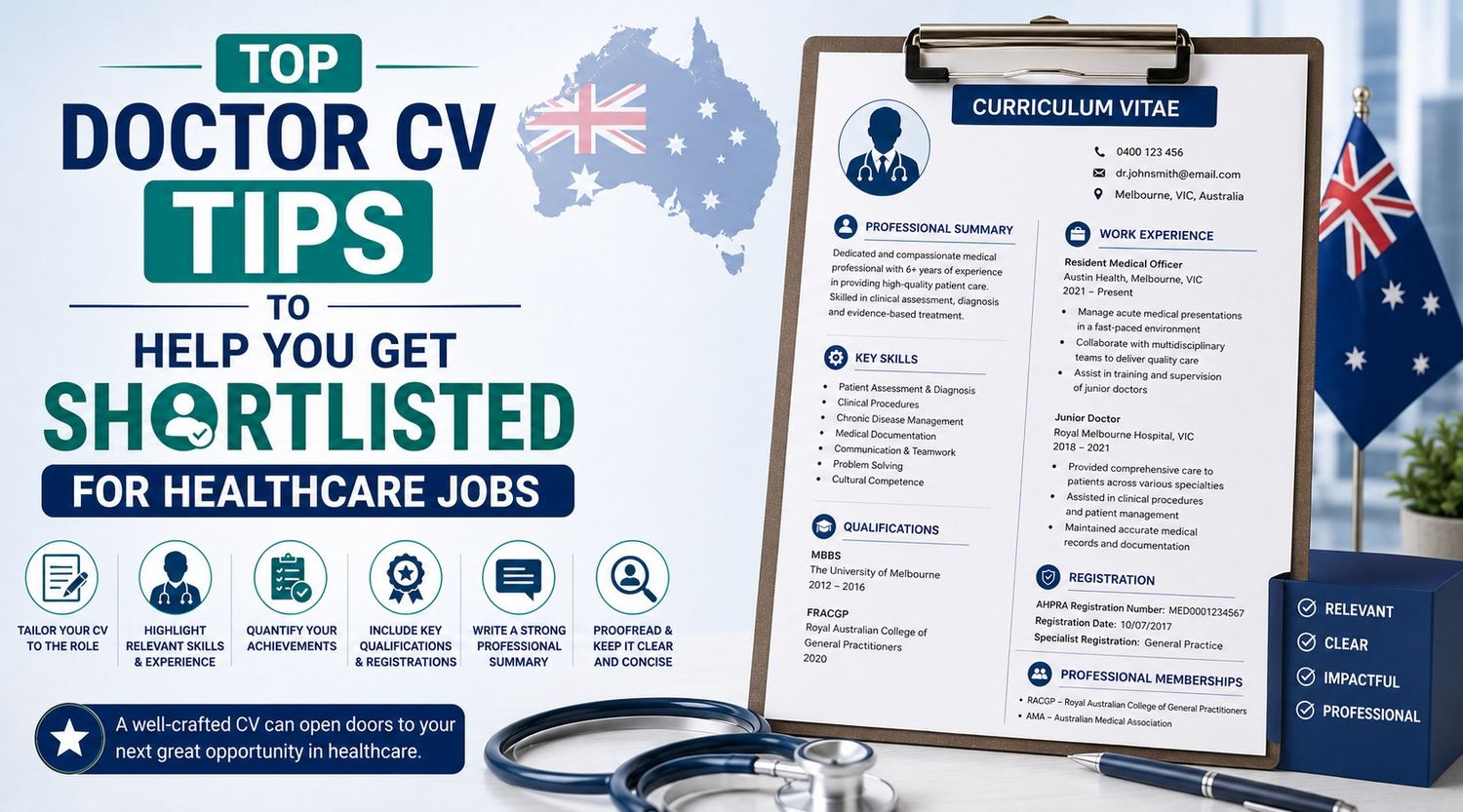
If you are looking for healthcare jobs it can get very competitive, especially in Australia’s hospital, private practice, specialist, locum and medical training environments. Whether you are a junior doctor, Resident Medical Officer, registrar, consultant, General Practitioner, locum doctor or International Medical Graduate, your CV is going to be a significant factor in whether you are shortlisted for interview.
A doctor’s CV is more than a career document. It is a professional summary of your clinical experience, registration status, medical qualifications, procedural skills, research, audits, teaching and suitability for the role. Your CV needs to be clear, not too generic and well formatted with all the necessary information or recruiters will move on quickly.
At DocTree we assist doctors and healthcare professionals to prepare structured, relevant and Australian healthcare compliant CVs. In this blog, we give you practical Doctor CV Tips to help you improve your medical job application and increase your chances of being shortlisted.
Why Your Medical CV Is Important
Medical employers and healthcare recruiters often sift through numerous applications for one position. Your CV needs to tell them quickly who you are, if you meet the requirements of the role and why you are a suitable candidate.
A good doctor CV should clearly show:
Your current career or medical role
Your eligibility or status of AHPRA registration
Your exposure to the hospital and clinical experience
Your field of expertise and relevant skills
Your certificates and qualifications
Your experience of the process.
Your research, auditing, teaching or leadership work
Your fit for the advertised role
Having these details at hand is going to make your CV work better. The goal is to make the recruiter’s decision easier by presenting your professional value in a simple and confident manner.
1. Clear Professional Header
Begin your CV with a clean, professional header. This section should include your full name, professional title, phone number, email address, city, state and AHPRA registration status (if applicable).
You may also include your LinkedIn profile if it is complete and professional. No personal stuff or idiots email addresses.
Example:
Dr. Sarah Williams
Residente Medico
Melbourne, Victoria
Mobile: 04XX XXX XXX
Email:sarah.williams@email.com
General Registration AHPRA Registration
This little snippet lets recruiters immediately identify your contact details and professional standing.
2. Create a Strong Professional Summary
Your professional summary should be concise, specific and relevant to the role. It should give employers a quick snapshot of your experience, strengths and career direction.
Don’t use vague words and expressions such as “hard-working doctor seeking a challenging position”. Instead, sell yourself on your clinical background and value.
For example:
Resident Medical Officer with clinical experience in emergency medicine, general medicine and surgical rotations. * Expertise in patient assessment, clinical documentation, acute care support, and interdisciplinary collaboration. Postion in Australian health system hospital based medical seeking.
For senior doctors, the summary might include specialist expertise, fellowship status, leadership, subspecialty interests or years of consultant level experience.
One of the most important Doctor CV Tips is to make your summary role specific. If you are applying for a position in emergency medicine, emphasise acute care. If you’re applying for a GP role, focus on primary care, chronic disease management and patient continuity.
3. Place AHPRA Registration Details Near Top of Page
One of the first things employers look for in Australian medical jobs is AHPRA registration. Make sure you clearly state your registration status towards the top of your CV.
Include, depending on your situation:
Type of AHPRA registration
Registration number, if applicable
General enrolment
Specialist enrolment
Registration provisional.
Restricted registration
Status of registration application
AMC International Medical Graduates Status
If you are an International Medical Graduate, you may also need to include AMC exam progress, English language test status, visa status and eligibility to work in Australia.
Don’t make recruiters go digging through the CV for this information. The quicker you can give clear registration details, the quicker your application can be assessed by employers.
4. Tailor your CV for each role
It is a big mistake for doctors to send the same CV with each application. A personalised CV allows you to show the employer that your experience matches the job requirements.
Make sure to read the job advert carefully before applying. Clinical skills, department experience, registration requirements, keywords mentioned in job description Then, tailor your CV to showcase the most relevant information.
For instance:
Highlight your skills in acute care, triage, trauma, resuscitation, and procedures for emergency medicine.
For GP positions emphasise chronic disease management, preventive care, mental health presentations, telehealth and continuity of care.
For surgical posts, highlight theatre exposure, surgical assisting, ward management and pre- and post-operative care.
Emphasise flexibility, broad clinical experience, record keeping, communication and being contactable for locum work.
Tailoring doesn’t mean changing your experience. It means to present the most relevant information in a clear manner.
5. Maintain a Clean and Professional Format
Recruiters have to skim through your CV quickly. A clean structure makes key details stand out and improves readability.
Use:
Headings Clearly
Standard spacing
Professional font
Reverse chronological order.
Bullet points:
Easy Margins
PDF format, unless otherwise requested
Haven’t
Templates that are Over-designed
Colours are too many
Extensive blocks of text
Too many graphics.
Date formats inconsistent
Tiny fonts
Long paragraphs
As a doctor you can have a longer CV than a normal resume but it should still be well organised and easy to scan. Junior doctors may have 2-4 pages but specialists, consultants and academic doctors may need more space to accommodate their research, publications, teaching and leadership.
6. Be Upfront About Clinical Experience
The clinical experience section is arguably the most important part of your CV. This should describe what you did, where you worked, in what departments, and at what level of responsibility.
For each role include:
Position title
Hospital, clinic or healthcare organisation
Place
Dates of Employment
Speciality or department
Main responsibilities
Clinical experience or relevant accomplishments
Rather than writing:
Worked in the emergency department.
Write:
Assessed and managed acute presentations under consultant supervision including initial assessment, investigation follow-up, treatment planning, documentation and coordination with the nursing and specialist teams.
The second version lets employers see more clearly what you can do. Use action-focused language and clinical detail as appropriate.
7. Add Key Clinical Skills section
A specific section on clinical skills helps the recruiters match your CV to the job quicker. This should be related to the position you are applying for.
Examples may include:
Patient examination
Management of acute care
Rounds
Medical documentation
Emergency presentations
Review of medications
Interpretation of diagnostic
Planning for discharge
Assistance in procedure
Chronic care for disease
Surgical support
Telehealth appointments
Multidisciplinary Communications
Medical electronic records
Patient information
Don’t try to list every skill you possess. Concentrate on skills that are authentic to you and are also on the job ad.
8. Technical Skills and Procedures
For many medical positions, it’s important to get procedural exposure. A procedures section can add value to your CV, particularly if you’re applying for jobs in emergency medicine, anaesthesia, intensive care, surgery, obstetrics and general practice.
Examples could include:
Venipuncture
Cannulation
Arterial blood gas sampling
Suture
Catheterization
ECG Interpretation .
Treatment of Wounds
Airway support
Splinting and Plastering
Helping out in the theatre
Simple ultrasound exposure
Include only those procedures with which you are competent or have appropriate supervised experience. When writing a medical CV, honesty and accuracy are crucial.
9. Research, Audits and Quality Improvement Highlights
Research, audits and quality improvement projects can help make your CV stronger if you are applying for registrar pathways, hospital roles, specialist roles or academic opportunities.
Add to that:
Research projects
Articles published
Case histories.
Poster Posters
Presentations at Conferences
Clinical Audit
Quality improvement projects
Kindly provide the project title, department, date, your role and the outcome if you have it. If you are doing an audit, kindly provide the same.
Here’s a look at some of the top 5 things to do in Hawaii.
“Conducting a medication safety audit to assess the accuracy of discharge prescriptions in a general medicine ward, allowing for recommendations to improve documentation and review processes.”
This demonstrates your work in clinical governance, patient safety and service improvement.
10. Add Teaching & Leadership Experience
Medicine values teaching and leadership skills. Have you supervised students? Taught junior doctors? Conducted tutorials or contributed to training sessions? Put this in your CV.
Teaching examples include:
Teaching at the bedside •
Medical Students Tutorials
Teaching clinical skills.
Simulation sessions
Mentoring of junior staff
Help with exam preparation.
Examples of potential leaders are:
Membership on committees
Support for rostering
Safety and Quality Meetings
Coordination of clinical team
Projects for health promotion
Liaison roles within the department
These sections help paint communications, initiative, teamwork and professional maturity.
11. Add appropriate certifications and professional development.
If you have current training and certifications, it can make your application stronger, particularly for hospital and acute care jobs.
Include related training such as:
BLS – Basic Life Support
Advanced Life Support (ALS)
Advanced Paediatric Life Support
Resuscitation of the Newborn
Infection prevention and control
Manual Handling 2 2.
Training on mental health
Cultural Safety Education
Procedural Sedation Education
The project is due to be completed by the end of 2026. Professional development shows your commitment to safe, contemporary clinical practice.
12. Use Keywords Organically
Many health care employers and recruitment agencies use applicant tracking systems or structured screening processes. Include relevant keywords from the job advertisement in your CV.
For example, if the role references “AHPRA registration”, “emergency medicine”, “RMO”, “ward rounds”, “clinical documentation”, “patient assessment” or “multidisciplinary team”, naturally include these terms where relevant.
Do not keyword stuff. It still has to look professional. CV The idea is to mimic your real experience with the language employers use.
13. Proofread before you send
Spelling errors, wrong dates, formatting issues, or incorrect details can kill your application. In healthcare, the devil is in the details.
Before you send in your CV, check:
Grammar and spelling
Employment dates
Hospitals and Clinics Names
AHPRA information
Titles of qualifications
Consistent formatting
Contact Information
Details of referee, if any
It’s good to get someone else to look over your CV before you apply too.
14. Maintain Professional Referees
Medical employers may require referees as part of the recruitment process. Appropriate referees could be consultants, clinical supervisors, heads of department, training supervisors or senior colleagues.
If the advertisement does not ask for referee details, you can write:
“Referees on request.”
Always ask for permission before listing someone as a referee. Ensure their contact details are correct and that they are prepared to discuss your clinical performance.
How DocTree Can Help You
Looking for healthcare jobs can be intimidating, particularly when you’re competing for hospital jobs, specialist training posts, GP positions, locum work or your first Australian medical job.
DocTree’s experts know what Australian healthcare employers are looking for in a doctor’s CV. We help doctors with structure, readability, clinical presentation, keyword alignment and role-specific tailoring.
Whether you need a complete CV rewrite, a professional review, or handy Doctor CV Tips for that specific role, DocTree can help you present your experience clearly and confidently.
In Closing
A good doctor CV can help you get shortlisted by clearly setting out your qualifications, registration status, clinical experience and suitability. The best CVs are clear, structured, tailored and aligned to Australian healthcare expectations.
Take a good look at your CV before you send in your next healthcare job application. Make sure it showcases your most relevant experience, is professionally formatted and clearly supports your application.
Book a consultation with one of our experts today and let DocTree help you build a stronger doctor CV for your healthcare job applications.
FAQs on Doctor CV Tips
1. What are the best tips for a doctor CV for healthcare jobs?
Top Doctor CV Tips Use a clear format Put your AHPRA registration near the top Tailor your CV for each role Describe your clinical experience clearly Add relevant skills Include certifications Proofread before you submit
2. How to make your CV stand out as a doctor?
You can make your doctor CV stand out by writing a strong professional summary, highlighting relevant clinical experience, adding role-specific skills, including research or audit work and tailoring the CV to the job advertisement.
3. Do doctors have to customise their CV for each application?
Yes. – Adapt your CV for each application, doctors. This provides employers with a quick snapshot of how your experience corresponds to the role, speciality, department, or healthcare setting.
4. Where to put AHPRA registration on a doctor CV
Your doctor CV should ideally have your AHPRA registration at the top of the page, in your header or in a dedicated registration section. This makes it easy for Australian employers to determine your eligibility.
5. How long should a doctor’s CV be in Australia?
A junior doctor’s CV may be two to four pages long. For registrar, consultant, specialist or academic doctors a longer CV may be needed to include research, publications, audits, teaching and leadership experience.
6. What clinical skills to put on a CV for doctors?
Doctors may employ clinical skills such as patient assessment, acute care, clinical documentation, ward rounds, diagnostic interpretation, discharge planning, procedural assistance, telehealth consultations and multidisciplinary communication.
7. Do International Medical Graduates need to include AMC status on their CV?
Yes. For International Medical Graduates include AMC status, AHPRA pathway, English language test status (if relevant), visa status (if relevant) and a clear explanation of overseas clinical experience.
8.What’s the best format for a doctor CV?
The best format is clean, professional, and scannable. Use clear headings, consistent spacing, bullet points, reverse chronological experience, and PDF format unless the employer requests another file type.
9. Here are a few mistakes that doctors need to avoid in their CV.
Doctors should steer clear of vague registration details, generic summaries, poor formatting, unexplained gaps, spelling mistakes, vague descriptions of experience, irrelevant information and sending the same CV for each role.
10. Where can I get help with my doctor resume?
DocTree can help you review, rewrite and optimise your doctor CV for jobs in Australian healthcare. Book a Consultation with one of our experts now and get expert help with your medical CV.