
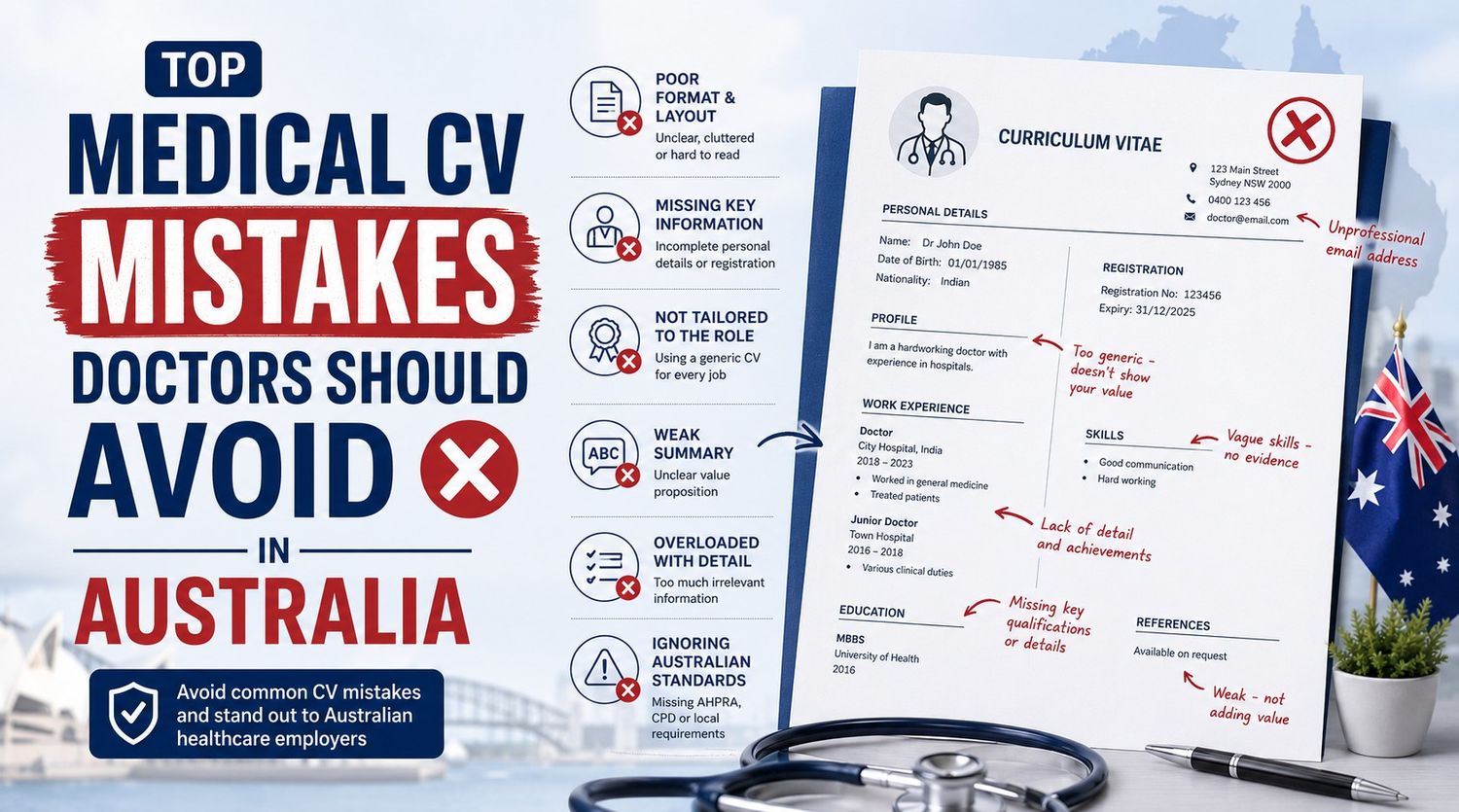
A doctor’s CV is not just a list of qualifications and job titles. In Australia’s competitive healthcare industry it is the first document a hospital, clinic, recruitment agency or medical employer will use to assess your suitability for a position. If you’re a junior doctor, Resident Medical Officer, registrar, consultant, specialist, General Practitioner, locum doctor or International Medical Graduate your CV must clearly communicate your clinical experience, registration status, qualifications, skills and professional value.
Unfortunately, many doctors miss out on interview opportunities due to lack of clarity, out of date CVs, poor structuring and lack of understanding of what Australian healthcare providers are looking for. Identifying the most common doctor’s cv mistakes can help you avoid mistakes that can weaken your application and reduce your chances of being shortlisted.
At DocTree, we offer professional CV advice to doctors and other healthcare professionals who are looking for work in Australia’s medical job market. This blog lists the most common medical CV mistakes doctors should avoid in Australia and how to build a better, clearer, and more employer ready CV.
The Importance of Medical CV Quality in Australia
Australian healthcare employers often receive multiple applications for a single medical role. Recruiters and hiring managers may only have a few minutes to skim each CV before deciding whether to take the candidate forward.
A good medical CV should enable them to quickly grasp:
What is your current role and experience level?
Your eligibility or registration with AHPRA
Your clinical background and practice areas
Your hospital, clinic or specialist experience
Your clinical and procedural expertise
Your education and abilities
Your background in research, audit, teaching or leadership
Your suitability for the job advertised
If these details are difficult to find, patchy or poorly presented, your CV may not create the right impression. By avoiding the common doctor’s cv mistakes you can make your application more professional, readable and competitive.
Mistake 1: Using the same CV for every job you apply for
Doctors often make the mistake of sending the same CV for every role. A generic CV can include your experience but it may not clearly reflect why you are suitable for the specific position.
For example, the CV for an emergency medicine position should emphasise acute care, triage, resuscitation exposure, procedural skills, rapid decision-making and multidisciplinary teamwork. A CV for a GP job will be more about continuity of care, chronic disease management, preventive health, patient communication and community-based practice.
Employers want to see relevance. Customising your CV isn’t about changing facts. That means putting the most relevant experience, skills and achievements where they are easy to find.
How to prevent this mistake:
Go through the job description carefully and tailor your professional summary, key skills, and clinical experience highlights to the role.
Mistake 2: Not clearly stating AHPRA Registration Status
In Australia, registration status is one of the crucial pieces of information on a medical CV. But many doctors omit it, place it too far down the document, or describe it vaguely.
Employers need to know if you have current AHPRA registration, general registration, provisional registration, limited registration or specialist registration or if you are in the process of applying. This information can be especially important to International Medical Graduates.
Providing vague registration information may cause a delay in recruitment or confusion as to your eligibility.
How to not fall into this trap:
Put your AHPRA registration status near the top of your CV. If applicable, please provide your registration type, registration number, specialist pathway status, AMC progress or eligibility information.
Mistake 3 – Having a Weak Professional Summary
Your professional summary is one of the first things employers see. A bad summary can make your CV seem generic or unfocused.
You will see many doctors write bland statements such as “hard-working and dedicated medical professional seeking challenging role”. That sounds good, but doesn’t give employers enough useful information.
A good summary should be a concise statement of your medical background, years of experience, clinical exposure, registration status and role objective.
Example weak:
“Motivated Doctor seeking job in a good hospital.
Better example:
Medical Officer with clinical experience in emergency medicine, general medicine and surgical rotations • Strong experience in patient assessment, clinical documentation, collaboration with interdisciplinary teams and acute care support. “Seeking an RMO position in an Australian hospital.”
How to avoid this error:
Keep your summary specific, short and relevant to the job you are applying for.
Mistake 4: Difficult to Read and Poor Formatting
You want your medical CV to be professional, clean, and easy to scan. Over-designed templates, inconsistent spacing, small fonts, too many colours and large blocks of text can reduce readability.
Recruiters like CVs that have a logical structure and allow them to find key information quickly. Clarity is more important than a beautiful design.
The usual formatting problems are:
Inconsistent titles
Extended paragraphs
No bullet points
Unknown date formats
Overly many font styles
Pages full of people
Bad order of sections
Page layout not found
How to prevent this error:
Use clear headings, reverse chronological order, consistent formatting, professional fonts, and concise bullet points. Save the final CV as a PDF unless the employer requests another format.
Mistake 5: Listing Duties But Not Demonstrating Clinical Value
Many doctors define their responsibilities by just listing basic duties. Responsibilities are important, but your CV should also show the clinical exposure and value that you added to each position.
For example, don’t write:
Worked on the ward and saw patients.
Write:
Managed inpatient care provided under consultant supervision including clinical assessments, progress notes, investigation follow-up, discharge planning and coordination with nursing and allied health teams.
The second version better demonstrates your day-to-day clinical involvement to employers.
How to avoid:
Use action verbs and include the type of patients, settings, procedures, systems, and responsibilities you dealt with.
Mistake 6: Lack of Important Clinical Skills
A specific clinical skills section allows employers to easily align your profile to the requirements of the role. Some doctors skip this section entirely or list skills that are too generic.
“Communication” and “teamwork” for example are useful, but need to be underpinned by more specific clinical skills.
Depending on your position, you can include:
Patient evaluation
Acute care management
Presentations for Emergencies
Round 1
Patient documentation
Procedural help
Review of medication
Planning for discharge
Assessment for diagnosis
Managing chronic disease
Surgical support
Virtual health visits
Multi-disciplinary care
Patient Education
How to avoid making this mistake:
Add clinical skills specific to the role and relevant to the position you are applying for and supported by your work experience.
Mistake 7: Not clearly stating your overseas experience
Many IMGs will have strong overseas experience but their CV may not reflect this in a manner that Australian employers can easily understand.
For example, the names of hospitals, job titles, the structure of departments and levels of training might differ across countries. If your employer doesn’t understand your level of responsibility, your experience can be undervalued.
This is one of the common doctor’s CV mistakes that can impact IMGs applying for Australian medical jobs.
How to avoid this mistake:
Please describe in detail your duties, department, hospital type, patient contact, level of supervision, and primary responsibilities. Include AMC status (if applicable), English language test results, visa status, observerships and Australian clinical experience.
Mistake #8: Failing to Explain Employment Gaps
Career gaps are not necessarily a problem — especially in medicine. Doctors spend time on examinations, relocation, family responsibilities, research, registration pathways or further study. But unexplained gaps might cause questions.
Employers appreciate clarity. You don’t need to over-explain personal details, but you should be honest and professional when presenting your timeline.
How to avoid making this mistake:
If you have a gap, address it in a concise, professional way. “AMC exam preparation”, “clinical observership”, “moving to Australia”, “postgraduate study” or “career break”.
Mistake 9: Overlooking Research, Audit, Teaching and Leadership
Many doctors concentrate solely on clinical roles and forget to include research, audits, quality improvement, teaching, supervision, committee involvement or leadership experience.
These sections can enhance your CV, especially for registrar, specialist, academic and hospital based roles.
You may include:
Clinical Audit
Quality improvement projects
Research Papers
Case report:
Presentations at Conferences
Lessons
Supervision of medical students
Mentoring
Clinical governance activities
Participation in committees
How to avoid this trap:
Create separate sections for research, audits, teaching and leadership if you have relevant experience. Keep it simple and tidy.
Mistake 10: Using Non-Specific or Redundant Language
Medical CVs need to be professional and specific. Ambiguous language will hurt your application.
Common vague expressions include:
strong communication skills
Hard working doctor
Duties include patient care
Worked at hospital
Helped senior doctors
Handled many cases.
These phrases lack sufficient detail. Precise and clear explanations of responsibilities in clinical language will make for a stronger CV.
How to avoid this error:
Use specific examples, clinical terms, and measurable details where possible. Where appropriate, mention departments, patient groups, procedures, caseloads, systems or outcomes.
Error 11. Providing Too Much Unnecessary Information
Some doctors give too much personal detail, work experience that is not relevant, school accomplishments that are out of date, or long descriptions of positions that are not relevant to the medical position.
Your CV must be complete, but also focused. Employers want proof that you’re a fit for the job.
How to prevent this mistake:
Give priority to up-to-date and relevant medical experience. Summarise older or less pertinent information. Do not include personal information that is not specifically requested for the application.
Mistake 12: Not customising for ATS and recruiter screening
Many healthcare employers and recruitment agencies use an applicant tracking system or structured screening processes. If your CV doesn’t have the relevant keywords from the job description, it’s unlikely to score well in screening.
For example, if the job ad contains “AHPRA registration”, “emergency medicine”, “RMO”, “clinical documentation”, “ward rounds”, “general practice” or “multidisciplinary team”, then your CV should include matching terms where appropriate.
But that doesn’t mean stuffing keywords. That means using the language of the job you’re applying for and the language that reflects your real-life experience.
How to prevent this mistake:
Read the job ad and naturally include relevant keywords in your summary, skills and experience sections.
Mistake #13: Failing to Proofread
Spelling mistakes, grammatical mistakes, inconsistent dates and formatting issues can make your CV look rushed. In healthcare, the devil lies in the details. An avoidable error on a CV may raise questions about professionalism.
How to escape this trap:
Proofread your CV carefully and submit it. Check names, dates, hospital details, registration info, formatting, spelling. It’s also a good idea to get your CV reviewed professionally before applying.
What to Include in a Strong Doctor CV
In Australia, a professional medical resume will usually have:
Contact information
Professional Profile
Registration with AHPRA
Medical qualifications
Clinical experience
Important clinical skills
Professional experience
Technical skills and processes
Research, publications
Quality Improvement and Audit
Supervision and teaching
Ongoing professional development
Qualifications
Colleges memberships
References or referees on request
The order can vary based on your stage of career, speciality and desired role. The key point is that your CV should be clear, accurate, relevant and easy to review.
How DocTree Can Help You
It can be challenging to write a strong medical CV, particularly if you are applying for competitive hospital jobs, transitioning to the Australian healthcare system, preparing for specialist training or returning to clinical practice after a break.
At DocTree, we understand the format, language and presentation expected of Australian medical CVs. We help doctors spot common doctor CV mistakes, make their profile clearer and present their clinical experience in a professional, job-ready format.
Whether you are a junior doctor, IMG, registrar, specialist, consultant, GP or locum doctor, DocTree can help you to prepare a CV that better reflects your capability, experience and career goals.
Concluding Thoughts
Common medical CV mistakes can make a huge difference to your job application. A well-written and tailored CV will help employers understand your registration status, clinical experience, skills and suitability for the role. It also enhances your professional image and increases your chances of being shortlisted.
If you’re not sure if your CV is helping or hindering your application, professional guidance can help you improve it before you submit your next job application.
Book Now with one of our experts for Consultation and let DocTree help you in building a stronger, clearer and more competitive medical CV for Australian healthcare jobs.
FAQs Common Mistakes in a Doctor CV Australia
1. Top CV mistakes doctors make in Australia – and how to fix them
Common doctor CV mistakes include: unclear AHPRA registration details, poor formatting, generic summaries, missing clinical skills, unexplained employment gaps, vague descriptions of experience and not tailoring the CV for each role.
2. Why you need an AHPRA registration on your medical resume
Why is AHPRA registration important? Australian healthcare employers need to check if you are eligible to work. Your CV should clearly state your type of registration, your status and any relevant details so that recruiters can quickly assess your application.
3. How long is a doctor CV in Australia?
A doctor CV in Australia is, by and large, longer than a regular resume. A junior doctor’s CV might be two to four pages, whereas specialists, consultants and academics might need a longer CV listing publications, audits, presentations, teaching and leadership experience.
4. Are doctors supposed to adapt their CV for each job application?
Yes. Doctors should adapt their CV for each role by highlighting the most relevant clinical experience, skills, procedures and achievements. A targeted CV shows the employer quickly why you are right for the job
5. What NOT to do in your CV as an International Medical Graduate?
International Medical Graduates should avoid vague job titles, unexplained overseas experience, missing AMC or AHPRA details, vague visa status and generic descriptions. Their CV should clearly outline their clinical responsibilities, pathway to registration and readiness for the Australian health care system.
6. Can formatting impact a doctor’s resume?
Yes. Bad formatting can make your CV hard to read and can reduce your chances of being shortlisted. A doctor’s CV should be formatted with clear headings, uniform spacing, bullet points, reverse chronological order, and a professional layout.
7. CVs: Should doctors include research and audits?
Yes, doctors should include research, audits, quality improvement projects, publications, presentations and teaching experience as appropriate. These details can boost applications for hospital, registrar, specialist and academic positions.
8. How to Write About Clinical Experience in a Doctor CV?
Clinical experience is best described in clear, action-oriented bullet points. List department, patient group, clinical responsibilities, procedures, level of supervision, and multidisciplinary work as appropriate.
9. How can I improve my doctor CV for jobs in Australian healthcare?
- How to improve your doctor CV?
- Personalise your CV to the role
- Clearly state AHPRA registration
- Use professional formatting
- Include relevant clinical skills
- Explain overseas experience
- Proofread before submitting your CV
10. Where can I get help with fixing mistakes in my medical CV?
DocTree helps doctors spot and fix errors on their medical CVs. Book Now with one of our experts for Consultation to get professional guidance and to build a stronger CV for Australian healthcare jobs.